Lessons from a Lemonade Stand: An Unconventional Guide to Government by Connor Boyack
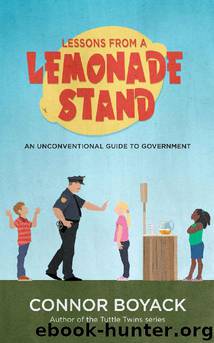
Author:Connor Boyack [Boyack, Connor]
Language: eng
Format: epub
Publisher: Libertas Press
Published: 2017-12-13T05:00:00+00:00
CREATOR AND CREATURE
Lest you think otherwise, let me make something clear: not everybody is a fan of natural law. One of its critics was a man named Jeremy Bentham, who called it “nonsense upon stilts.”4 Bentham was an eighteenth-century English philosopher and social reformer who believed that actions—and laws—should be evaluated not on their moral implications, but on their consequences. This concept, known as utilitarianism, measures what is right or wrong based on “the greatest happiness of the greatest number” of people. This, he argued, was “the only right and justifiable end of government.”5
In other words, Bentham believed that the purpose of government was to improve the lives of the most people possible—good ends would justify whatever means were used to obtain them. You might wonder, as I do, whether the happiness of the majority of people is a praiseworthy result if it is achieved by hurting the minority of people. If 51% of people in a country would be most happy by taking half of the money and belongings of the other 49%, is there anything wrong with that? If law is not connected to morality, then does it matter if some people are disadvantaged by the law? Some will be peasants and some will be kings and knights—and that’s okay in this way of thinking, as long as the privileged politicians and their friends are happy.
This dangerous idea was further refined by one of Bentham’s students, John Austin, the British legal theorist mentioned earlier who championed positive law. A professor of jurisprudence at the University of London, Austin refined and propagated these ideas even further. How did he do it? Well, how would you do it? If you’re a utilitarian and you wish to govern a society based only on the merits of the outcomes of each law or action, what type of government would you need? Where would the authority come from in such a scheme?
Austin argued that “every political society must have a sovereign… freed from legal restraints.” In other words, the government and its officers should be exempted from any negative legal consequences for their actions. Those in government should not be “constrained to observe [the law] by any legal sanction,” or punishment. But why a separate set of rules for the government versus those who are governed by this group of people? Because if the government had to follow its own rules, Austin wrote, it “would be in a state of subjection,” rather than sovereign, or supreme.6
Surely your mind begins spinning at the thought of letting the government get away with whatever it wants. This sounds like something out of a dystopian novel. But Austin was very influential in the decades that followed, and modern governments implement the very thing he championed.
Ever heard of sovereign immunity? It’s the idea that government can do no wrong and cannot be sued by those who have been harmed by its actions. This idea dates back to the early monarchy in England, where kings could not be sued in their own courts.
Download
This site does not store any files on its server. We only index and link to content provided by other sites. Please contact the content providers to delete copyright contents if any and email us, we'll remove relevant links or contents immediately.
The Thirst by Nesbo Jo(6905)
Permanent Record by Edward Snowden(5807)
The Myth of the Strong Leader by Archie Brown(5479)
Spare by Prince Harry The Duke of Sussex(5164)
A Higher Loyalty: Truth, Lies, and Leadership by James Comey(4937)
Secrecy World by Jake Bernstein(4724)
Adulting by Kelly Williams Brown(4549)
The Borden Murders by Sarah Miller(4298)
Machine Learning at Scale with H2O by Gregory Keys | David Whiting(4279)
Killers of the Flower Moon by David Grann(4022)
American Kingpin by Nick Bilton(3851)
Fear by Bob Woodward(3685)
The Secret Barrister by The Secret Barrister(3680)
Future Crimes by Marc Goodman(3578)
The Last Girl by Nadia Murad(3487)
The House on Mango Street by Sandra Cisneros(3448)
Liar's Poker by Michael Lewis(3429)
Oathbringer (The Stormlight Archive, Book 3) by Brandon Sanderson(3100)
The Social Psychology of Inequality by Unknown(3005)
